Tuesday, December 18, 2007

Peter Bjorn and John - Writers Block


Months before Writer's Block landed in US record stores,
subdued Swedish rockers Peter Bjorn and John had already worked music bloggers into a frenzy with their '60s pop-channeling tune "Young Folks." Employing buoyant bass lines, congas, bongos and an infectious whistle, the dreamy duet featuring The Concretes' Victoria Bergsman quickly became an indie anthem. Luckily the trio's third full-length—a lovely little album brimming with catchy indie pop—isn't outshined by the luster of its first single. The brooding "Up Against the Wall" is sure to win over listeners with its melodic guitar chords and gentle piano accents, while the fuzzy, noise-soaked "Start to Melt" and the ethereal "Roll the Credits" both contribute to the album's hypnotic grace. But it's on the lilting "Paris 2004," in which lead crooner Peter Morén recounts a languid morning of bed-lolling, half-eaten croissants and requited love, that PB&J's accomplishment is revealed: an ability to craft blissful tunes that resonate on the most intimate of levels. Like the two, dewy-eyed characters intone to each other in "Young Folks," listening (and listening and listening) to Writer's Block can cause everything else to just fade away.


- James Jung

Yo La Tengo - I Am Not Afraid of You and I Will Beat Your Ass


After the elegant, introspective romantic narratives of And Then Nothing Turned Itself Inside-Out and the beautifully crafted but restrained pop textures of Summer Sun, it was hard not to wonder if Yo La Tengo was ever going to turn up the amps and let Ira Kaplan go nuts on guitar again, and for more than a few fans "Pass the Hatchet, I Think I'm Goodkind," the opening cut from YLT's 2006 album I Am Not Afraid of You and I Will Beat Your Ass, will feel like the reassuring sound of a homecoming -- ten minutes of noisy six-string freak-out, with James McNew's thick, malleable basslines and Georgia Hubley's simple but subtly funky drumming providing a rock-solid framework for Kaplan's enthusiastic fret abuse. After the thematic and sonic consistency of their previous two major albums, I Am Not Afraid marks a return to the joyous eclecticism of 1997's I Can Hear the Heart Beating as One, though nearly ten years down the road Yo La Tengo sounds noticeably more confident in their embrace of different styles and less hesitant in their technique on this album -- even Kaplan's gloriously unkempt guitar solos start to suggest a certain degree of well-earned professionalism. The songs also sound a shade less playful and more disciplined, though the group's ability to bring their distinct personality to so many different styles attests to their continuing love of this music and the quiet strength of their vision -- the neo-Byrds-ian psychedelia of "The Race Is on Again," the homey horn-punctuated pop of "Beanbag Chair," the plaintive folk-rock on "Black Flowers," the aggressive Farfisa-fueled minimalisms of "The Room Got Heavy," and "Daphina," which suggests a John Fahey track transcribed to piano and then used as the root for a eight-minute exercise in low-key atmospherics, all function on a different level and each one satisfies. What's both engaging and impressive about I Am Not Afraid of You and I Will Beat Your Ass is that, as usual, these 15 songs always end up sounding like Yo La Tengo, whether they're upbeat guitar pop or dense loop-based drones, and if there's a bit less childlike élan here than in the past, there's also an intelligence and joy that confirms Yo La Tengo is still one of the great treasures of American indie rock, and they haven't run out of ideas or the desire to make them flesh in the studio just yet.


~ Mark Deming, All Music Guide

Monday, December 17, 2007

Revolver - The Beatles


All the rules fell by the wayside with Revolver, as the Beatles began exploring new sonic territory, lyrical subjects, and styles of composition. It wasn't just Lennon and McCartney, either -- Harrison staked out his own dark territory with the tightly wound, cynical rocker "Taxman"; the jaunty yet dissonant "I Want to Tell You"; and "Love You To," George's first and best foray into Indian music. Such explorations were bold, yet they were eclipsed by Lennon's trippy kaleidoscopes of sound. His most straightforward number was "Doctor Robert," an ode to his dealer, and things just got stranger from there as he buried "And Your Bird Can Sing" in a maze of multi-tracked guitars, gave Ringo a charmingly hallucinogenic slice of childhood whimsy in "Yellow Submarine," and then capped it off with a triptych of bad trips: the spiraling "She Said She Said"; the crawling, druggy "I'm Only Sleeping"; and "Tomorrow Never Knows," a pure nightmare where John sang portions of the -Tibetan Book of the Dead into a suspended microphone over Ringo's thundering, menacing drumbeats and layers of overdubbed, phased guitars and tape loops. McCartney's experiments were formal, as he tried on every pop style from chamber pop to soul, and when placed alongside Lennon's and Harrison's outright experimentations, McCartney's songcraft becomes all the more impressive. The biggest miracle of Revolver may be that the Beatles covered so much new stylistic ground and executed it perfectly on one record, or it may be that all of it holds together perfectly. Either way, its daring sonic adventures and consistently stunning songcraft set the standard for what pop/rock could achieve. Even after Sgt. Pepper, Revolver stands as the ultimate modern pop album and it's still as emulated as it was upon its original release.


~ Stephen Thomas Erlewine, All Music Guide

Okkervil River - The Stage Names


After the elegant, introspective romantic narratives of And Then Nothing Turned Itself Inside-Out and the beautifully crafted but restrained pop textures of Summer Sun, it was hard not to wonder if Yo La Tengo was ever going to turn up the amps and let Ira Kaplan go nuts on guitar again, and for more than a few fans "Pass the Hatchet, I Think I'm Goodkind," the opening cut from YLT's 2006 album I Am Not Afraid of You and I Will Beat Your Ass, will feel like the reassuring sound of a homecoming -- ten minutes of noisy six-string freak-out, with James McNew's thick, malleable basslines and Georgia Hubley's simple but subtly funky drumming providing a rock-solid framework for Kaplan's enthusiastic fret abuse. After the thematic and sonic consistency of their previous two major albums, I Am Not Afraid marks a return to the joyous eclecticism of 1997's I Can Hear the Heart Beating as One, though nearly ten years down the road Yo La Tengo sounds noticeably more confident in their embrace of different styles and less hesitant in their technique on this album -- even Kaplan's gloriously unkempt guitar solos start to suggest a certain degree of well-earned professionalism. The songs also sound a shade less playful and more disciplined, though the group's ability to bring their distinct personality to so many different styles attests to their continuing love of this music and the quiet strength of their vision -- the neo-Byrds-ian psychedelia of "The Race Is on Again," the homey horn-punctuated pop of "Beanbag Chair," the plaintive folk-rock on "Black Flowers," the aggressive Farfisa-fueled minimalisms of "The Room Got Heavy," and "Daphina," which suggests a John Fahey track transcribed to piano and then used as the root for a eight-minute exercise in low-key atmospherics, all function on a different level and each one satisfies. What's both engaging and impressive about I Am Not Afraid of You and I Will Beat Your Ass is that, as usual, these 15 songs always end up sounding like Yo La Tengo, whether they're upbeat guitar pop or dense loop-based drones, and if there's a bit less childlike élan here than in the past, there's also an intelligence and joy that confirms Yo La Tengo is still one of the great treasures of American indie rock, and they haven't run out of ideas or the desire to make them flesh in the studio just yet.


~ Mark Deming, All Music Guide

Neutral Milk Hotel -In the Aeroplane Over the Sea


Perhaps best likened to a marching band on an acid trip, Neutral Milk Hotel's second album is another quixotic sonic parade; lo-fi yet lush, impenetrable yet wholly accessible, In the Aeroplane Over the Sea is either the work of a genius or an utter crackpot, with the truth probably falling somewhere in between. Again teaming with producer Robert Schneider, Jeff Mangum invests the material here with new maturity and clarity; while the songs run continuously together, as they did on the previous On Avery Island, there is a much clearer sense of shifting dynamics from track to track, with a greater emphasis on structure and texture. Mangum's vocals are far more emotive as well; whether caught in the rush of spiritual epiphany ("The King of Carrot Flowers Pts. Two and Three") or in the grip of sexual anxiety ("Two-Headed Boy"), he sings with a new fervor, composed in equal measure of ecstasy and anguish. However, as his musical concepts continue to come into sharper focus, one hopes his stream-of-consciousness lyrical ideas soon begin to do the same; while Mangum spins his words with the rapid-fire intensity of a young Dylan, the songs are far too cryptic and abstract to fully sink in -- In the Aeroplane Over the Sea is undoubtedly a major statement, but just what it's saying is anyone's guess.

~ Jason Ankeny, All Music Guide

The Grey Album - Jay Z/The Beatles


1 Public Service Announcement
2 What More Can I Say
3 Encore
4 December 4th
5 99 Problems
6 Dirt Off Your Shoulder
7 Moment of Clarity
8 Change Clothes
9 Allure
10 Justify My Thug
11 Interlude
12 My 1st Song

Death Cab for Cutie - Something About Airplanes


The fact that Elsinor and Barsuk, two relatively small labels, conspired to co-release Something About Airplanes should give some indication as to its quality. It's a solid, emotive, and frequently amazing indie rock record that could very well be considered somewhat important. Sonically, Death Cab for Cutie falls somewhere on the dreamier and more pop-oriented end of Built to Spill's sound (particularly on Keep It Like a Secret), alongside the Posies' most pensive tracks, or with Delta Haymax -- that is, dynamic, melodic, and somewhat atmospheric Northwestern rock. What's important, however, is that the composition, arrangement, and perfect vocal harmonies of Something About Airplanes are all hugely effective; the band uses light touches of flute, synth, or cello to add the necessary textures to its well-crafted pop songs, and the result has a consistently impressive and thoroughly engaging quality that rivals Built to Spill's Keep It Like a Secret. Which is quite a complement -- but tracks like "Bend to Squares" and "Pictures in an Exhibition" deserve as much adulation as one can offer.

-Nitsuh Abebe (All Music Guide)

Death Cab for Cutie - Plans


For your consideration: a wildly successful indie rock band with a legion of followers on an equally successful, highly credible independent label makes the jump to major-label powerhouse Atlantic, leading to much chagrin and speculation among its fans as they awaited with bated breath for what would happen to the group. The result was For Your Own Special Sweetheart, inarguably the most polished and fully realized album of Dischord alumnus Jawbox's career. Fast forward ten years and you find Barsuk's Death Cab for Cutie in the same position, making the same move. A new label, a larger crowd (thanks to their repeated appearances on The OC), and a side project of Ben Gibbard (Postal Service) that very well overshadowed the success of his main project. All of the moves were perfectly aligned to take the little band that could into the rock stratosphere. But the difference between Jawbox and Death Cab for Cutie was that For Your Own Special Sweetheart went on to be the finest release of Jawbox's canon. Plans definitely comes close to that mark, but falls slightly short. In comparison to the dry, raw production of Transatlanticism, Plans is warm and polished, the kind of album expected from a band obsessed with the sound of Fleetwood Mac's Rumours. Chris Walla does an amazing job bringing the group's sound in a different direction than before without compromising too many of the things that made the group sound great to begin with. Thematically, Plans is the Death Cab for Cutie suitable for graduate students, world-weary and wiser from their experiences, realizing they can no longer be love-starved 20-somethings without a clue yet hopelessly cursed to face the same issues. And there's merit to be had in acknowledging that maturity, for even blink-182 figured out their age and released their "serious" album. Gibbard's wispy, poetic lyrics (which could easily have been stolen from Aimee Mann's dressing room while she wasn't looking) still remain an artery from which the rest of the band beats and are some of his finest ever, but this time around the band aligns itself more with a series of emotional murmurs rather than a heart attack. The album winds its way from one ballad to the next, with brief stopovers at moderately up-tempo numbers to help break things up a bit. And it's this sense of resignation that either makes or breaks the album, depending on which Death Cab for Cutie is your favorite: the melancholic, hopeless romantic or the one who wears its heart on its sleeve with unbridled energy and passion. If Transatlanticism was Gibbard's Pet Sounds and Postal Service was SMiLE, then this is definitely Wild Honey, loved by adoring new fans and those who enjoy the ballads. But those hoping for a bit more -- for the bar to be raised higher -- might find this a mildly predictable exercise in Gibbard exorcising the demons of Phil Collins that haunt him. Plans is both a destination and a transitional journey for the group, one that sees the fulfillment of years of toiling away to develop their ideas and sound. But it's with the completion of those ideas that band is faced with a new set of crossroads and challenges to tread upon: to stay the course and suffer stagnation or try something bold and daringly new with their future. Which road they'll take will make all the difference.

-Rob Theakston (All Music Guide)

Death Cab for Cutie - Transatlanticism


As musical lunacy goes, things have gotten as crazy as it gets for Death Cab for Cutie since 2002's You Can Play These Songs With Chords compilation. A wildly successful tour with Dismemberment Plan, a collaboration for singer Ben Gibbard with emo-electronic guru Dntel under the Postal Service moniker, and a whole new legion of fans swooning to Gibbard's lyrics as if he were a modern day answer to Kiss Me-era Robert Smith have all amassed considerable hype around Transatlanticism. But the group proves themselves more than equal to the task, answering the call and proving the cynics wrong with their most focused and most mature work in their entire catalog. Transatlanticism wastes absolutely no time and dives in head first with "The New Year," one of the most melodramatic openings to an album since the Smashing Pumpkins' "Tonight, Tonight" from Mellon Collie and the Infinite Sadness. The mellow, mixed-meter percussion and dense atmosphere of "Lightness" is a brilliant lead into the pop-happy "Expo '86" and "The Sound of Settling" before setting up the climatic and intensely dramatic title track. Unconsciously taking a page from Blur's "Sing," the hypnotic drumming and guitar call and responses through the eight-minute climax of the album are backed with a singalong finale that unquestionably will have every audience on the next tour singing along and holding up their lighters. And while most albums would be left exhausted after such a track, the group keeps things moving, albeit at a much slower pace than compared to the anthems that packed the first half. Gibbard seamlessly makes the transition between songs that full out rock to songs that are comparable to Elliott Smith's finest hour with great ease. But it's Gibbard's poetic lyrics and signature introspection that remain a bench mark for Death Cab; and it's the group's maturity as musicians as well as songwriters that make Transatlanticism such a decadently good listen from start to finish. The band has never sounded more cohesive, the track sequencing is brilliant, and it caps off a triumphant year for not only Gibbard, but a band whose time and greater recognition is finally due.

-Rob Theakston (All Music Guide)

Deerhoof - Milk Man


Deerhoof follows Apple O', an album that won the group ever-growing critical and popular acclaim, with Milk Man, an album even more conceptual and song-oriented than its predecessor. Inspired by the spooky yet adorable work of illustrator Ken Kagami -- whose art graces the album's cover and liner notes -- Milk Man tells the tale of a masked, pied piper-like being who lures children into his dreamland and then traps them there. The vision and the visuals surrounding the album are a perfect fit with Deerhoof's music, and, perhaps befitting Milk Man's status as a concept album, this time around the band incorporates more prog rock-like keyboards and other electronics into its sound. The pretty ballad "Dream Wanderer's Tune," with its lyrics about kings in castles in the sky and its playfully elaborate keyboards, exemplifies Deerhoof's move to more intricate, contemplative music. Since the album is relatively restrained, it's not quite as buoyant as Apple O' or Reveille, and it lacks a little bit of the delirious overload of Deerhoof's earliest work, but that doesn't mean that it's less distinctive. "Desapareceré" is one of Milk Man's best and most unique tracks, mixing clicking and shuffling electronic drums with sugary synths and Spanish lyrics into a very different take on electronic pop; "Dog on the Sidewalk" consists mostly of bubbling and fizzing electronics and Satomi Matsuzaki's deceptively simple vocals. Milk Man does have its fair share of noise, particularly on the instrumentals "Rainbow Silhouette of the Milky Rain" and "That Big Orange Sun Run Over Speed Light," as well as on "Song of Sorn," which starts out as a burst of noise and ends up oddly, but distinctly, poppy. This poppiness is responsible for many of Milk Man's best moments, including the sunny title track and "Milking" -- which are among the most straightforwardly melodic songs Deerhoof have ever written -- as well as the sweet final track, "New Sneakers," which does indeed capture the childlike glee of new shoes in lyrics like "Skipping all over with these shoes/Oh speed." Milk Man isn't all sweetness and light, though: Greg Saunier's lumbering drumming adds an extra edge to the monster party that is "Giga Dance"; "C"'s brittle vocal melody is mirrored by guitars that are pretty at first but then turn loud and thrashy. But even in its louder moments, Milk Man is a surprisingly subtle album, and one that takes Deerhoof's music in quietly exciting new directions.


~ Heather Phares, All Music Guide

Cursive - The Ugly Organ


Whereas 2000's Domestica explored the intense pain of Tim Kasher's divorce, Ugly Organ is a tale of empty sex, overwrought melodrama, and metaphors of which the album's title is only the first. Kasher likes making you feel queasy, and Cursive backs him up with unpredictable instrumental turns. "Butcher the Song" could be about a lot of things, but it's definitely not happy, and its instrumentation lurches in stops and rushing starts like a drivetrain gone bad. "Art Is Hard" is much louder. "Keep turning out those hits! Till it's all the same old sh*t!" The clattering guitars shoot backward at Cursive's louder roots, but the knifing lyrics stab wildly at fans, the band, the industry -- any target available. Kasher and co. are similarly restless throughout Ugly Organ, and that sentiment makes the album both rewarding and frustrating. They're capable of great beauty, particularly in the sure hand of cellist Gretta Cohn, who first appeared on the Burst & Bloom EP but is a true force here. She adds a soaring melody to "Driftwood: A Fairy Tale," making it sound like Spoon with a fuller lineup. But the band also throws a thousand ideas into the wind on Organ, and a lot of them become just hints and melodrama. The ten-minute "Staying Alive" is flush with intensity but goes in too many different directions, while the brief "Herald! Frankenstein" doesn't expand far enough. Kasher's always pretty clear with his lyrics; he's having a post-coital conversation in "Gentleman Caller," he's the post-divorce depressive in "Recluse." But Cursive could use a little more clarity throughout Ugly Organ, to fully capture the band's fractured and anxious, but always exuberant sound.

-Johnny Loftus (All Music Guide)

Cold War Kids-Robbers and Cowards


Having shaped their sound and imagery with three EPs for Monarchy Music and a demanding touring schedule, it's not a surprise that Cold War Kids have more presence on their first full-length, Robbers & Cowards, than many bands do on their debut albums. Their evocative, oddly soulful vignettes contain shades of Spoon's sardonic, piano-driven rock; the insistent, jittery feel of One Time Bells-era French Kicks; the poetic, rumpled ramblings of the Walkmen; the stripped-down bluesiness of the White Stripes; and in their more theatrical moments, a ghostly trace of Jeff Buckley, as well as touches of folk and gospel. That's not to say that Cold War Kids are derivative -- it's more like they take inspiration in classic sounds (indie or otherwise) and tweak them to their own designs. And even if there's more comforting, built-in familiarity with a touch of freshness in their music than radical originality, there's something to be said for familiarity, especially when it's done this well. For fans of the band's EPs, Robbers & Cowards will sound familiar for another reason: it takes most of its songs from Up in Rags and With Our Wallets Full, giving them a slightly fuller, cleaner sound. Fortunately, this only enhances the band's most distinctive assets: Nathan Willett's high-pitched, nasal, vibrato-heavy voice, a love it or hate it instrument that gives Cold War Kids a huge part of their character, and their way with storytelling and lyrics with a bookish eye and ear for detail. "We Used to Vacation," a dry-eyed account of alcoholism's effect on a family, and "Passing the Hat," a tale of stealing from the collection plate at church that sounds like it could be from an indie rock musical about the Great Depression, combine both to great effect, but it's the genuine warmth in "Hospital Beds" that makes it the finest moment on an exciting, accomplished debut album.

~ Heather Phares, All Music Guide

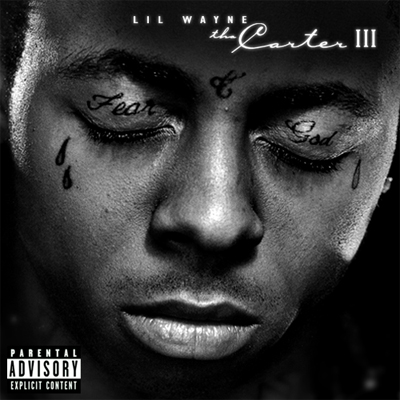
Lil Wanye-Carter III Mixtape


1. What he does
2. Diamonds and girl feat. currensy
3. Kush
4. La la
5. Something you forgot
6. Zoo feat. mack maine
7. I know the future (prod. by matlock) feat. mack maine
8. Im raw
9. Scarface
10. Im me
11. Time for us to fuck
12. Beat without bass
13. When you see me feat. baby
14. Money ova here feat. stacks
15. Hardbody
16. I feel like dying
17. Prostitute fling
18. Get out
19. Im a beast
20. Did it before (prod. by kanye west)
21. Help
22. The perfect man
23. Be me

Sunday, December 16, 2007

Girl Talk-Night Ripper


Gregg Gillis has been cutting up and gluing bits and pieces of songs together as a DJ in Pittsburgh since his 2002 debut, Secret Diary, an album that, though a lot of easily identifiable samples (the Price Is Right theme, for example) were used, was so delayed and skipped and glitched that it was too obfuscated to do much in the mainstream. Such is not the case with Night Ripper, however, which, thanks to Gillis's ability to draw from a myriad of musical sources (the names of the artists used, though not their songs, are listed in alphabetical order inside the liner notes, and in fact make up the entirety of the liner notes), can appeal to anyone who's heard the radio (particularly rap radio) in the past few years. Because of the recognizability of the pieces used, Night Ripper is a good tool for showing listeners unfamiliar with the art of sampling what a talented DJ can actually do; Gillis' favorite trick on the album is to play a long vocal track, preferably something from the Ying Yang Twins or Ludacris, over rock (be it classic, indie, or grunge) beats, which he speeds up or slows down as necessary. It's pretty impressive, and at first listen, it's pretty fun. On the opener, "Once Again," Luda's "Pimpin' All Over the World" moves into the Twins' "Wait (The Whisper Song)" over the Verve's "Bittersweet Symphony," which then turns into Slim Thug's "I Ain't Heard of That" plus the acoustic guitar of Oasis's "Wonderwall," all of which ends with the Five Stairsteps' oft-sampled "O-o-h Child." Actually, "ends" is not really the right term, as the whole album works as one piece, the track titles only serving to help those more song-inclined not feel as if they are in foreign electronica territory, with its 50-minute sides and incomprehensible blips and bleeps. The thing is, this openness to pop culture, while it may increase and amuse his audience, also serves to make the album a fleeting affair. How many times do you really want to hear Fleetwood Mac's "Little Lies" trade off with the 69 Boyz's "Tootsie Roll?" Or Sophie B. Hawkins mix with Panjabi MC and Better Than Ezra while the Game's vocals from "Hate It or Love It" play over? The very thing that makes Night Ripper entertaining, its basis on current hits and long pop-song breaks, is also the thing that kills it, that makes it lose its appeal after a few spins; good for one party, one car trip, one afternoon at the beach, and that's all. Which isn't to say, however, that that one hour can't be a whole lot of fun.

~ Marisa Brown, (All Music Guide)

Wednesday, December 12, 2007

The Blood Brothers - Burn Piano Island, Burn


Higher-pitched and noisier than an army of little dogs, the quintet of youngsters known as the Blood Brothers spew out a relentless wad of spit on Burn Piano Island, Burn, a ferocious album that singes the ears. Their passionate, insane, ranting hardcore is surely not for everyone. It's a truly extreme album at a time when the word "extreme" is used to sell snowboards and SUVs. The Blood Brothers features two singers trading off shrieking into the mic and surprisingly they're shrieking some really fancy lyrics, which is probably the most interesting aspect of the band. On the title song they yelp, "Charred toucans weaving their black sky quilt?/Burn piano island burn!/The seashells scream out celestial code/Melting on the shore inside a flame snow globe." All the lyrics are very much in this surreal poetry vein. An unusual band indeed. They occasionally, though not very often, slow up the torrent on songs like "Six Nightmares at the Pinball Masquerade" and "The Salesman, Denver Max," using, gasp!, acoustic guitars, pianos, and a xylophone. Kids looking to anger their parents to the point of losing it should pick up this CD, turn up the stereo, and lock the door.

-Adam Bregman (All Music Guide)

----------------------

Another album that reminds me of my first semester at college. All I have to say is listen to "Cecelia and the Silhouette Saloon." Picture robots fighting. They should have used this song for that last fight scene in Transformers. Maybe next time Michael Bay. Maybe next time...

-Shane

Tuesday, December 11, 2007

Alesana - On Frail Wings of Vanity and Wax


It's funny how some of these new post-hardcore emo type bands get a bad rap before they even release an album. One of those bands happens to be North Carolina's Alesana. They originally released On Frail Wings of Vanity and Wax on a small label called Tragic Hero but Fearless records caught wind of this youthful and energetic band and signed them with the condition that they get to re-release this album.

I found the album to go down quite easily. They have the typical today screamo sound so it ends up with a bit of a disposable factor. The sort of album that could have been about 100 other band's debut album, but that doesn't change the fact that Vanity and Wax is indeed listenable. They have the dual vocals thing down as well (screaming and singing). The singing portion is something that shouldn't be overlooked. Shawn Milke has some decent lungs. For that matter the screamer, Dennis Lee, fits in nicely too. So often dual vocals sound forced: the screams shoe-horned in at all the wrong times. Alesana don't have a problem dropping things out and creating some beautiful moments as well. Look to the "Third Temptation of Paris" and the cool piano and lovely vocal harmonies for something unique. The proper album opener (after the "Icarus" intro) is a good indication on if you'll appreciate Alesana.

If your buddies said to stay away from Alesana, do yourself a favor and make up your own mind. I think On Frail Wings Of Vanity And Wax is one of the better screamo releases out this year, Alesana proving there is still creativity left in a very crowded genre.

-MusicEmissions.com


---------------------------

Alesana is great to listen to when you're pissed off or just hyper and feel like screaming like a retard. Have a good time laughing when you listen to the uberemo spoken word intros to "Icarus" and "Alchemy Sounded Good At The Time." My favorite track is "Congratulations, I Hate You" based solely on the intro, great for listening to when you have a stupid ex girlfriend .

-Shane

Against Me! - Reinventing Axl Rose


Against Me!'s Reinventing Axl Rose is an impressive debut that manages to combine fist-in-the-air singalong choruses, lagered-up rhythms, and urgent drumbeats with the underground, raw intensity these punks are known for live. It's a dynamic record that not only stands firm in its own right, but also hints at a propensity for songwriting in Tom Gabel -- the group's hoarse, politically conscious singer/songwriter -- just starting to be fully realized. From the rowdy, country-influenced drinking anthem "Pints of Guinness Make You Strong," to the somber closing notes of "8 Full Hours of Sleep," Against Me! performs every track with the passion of those who truly believe a song among friends can start a movement for change. The band's leftist political agenda is often offset by empowering social lyrics boasting sentiments of unity, individualism, and self-awareness. Tracks like the lively and rebellious "Those Anarcho Punks Are Mysterious..." declare that "We rock/Because it's us against them/We've found our own reasons to sing," while the album's title track urgently professes, "Everyone would leave with the memory that there was no place else in the world and this was where they always belonged." Often deviating from the standard punk musical blueprint, Against Me!'s blend of energetic folk/punk rock is nothing short of refreshing and engaging. Reinventing Axl Rose is a true classic that brings listeners right into the dirty basements and dive bars that birthed the band -- and serves as the foundation to where they would head next.

-Corey Apar (All Music Guide)

The Faint - Wet From Birth


Since the breakout success the Faint had with 2001's Danse Macabre, the band's sound has become more mature and eclectic, as Wet from Birth, the group's fourth album, demonstrates. Relying less on overpowering synths and more on subtle electronics, prickly guitar work, and heavy, often chopped-up beats, the band sounds both more rock and more overtly electronic than it ever has before, while avoiding dated electroclash pitfalls. Though the Faint still mines the '80s for inspiration, the band seems to be moving forward, however slightly, with songs like album opener "Desperate Guys," which sets a typically Faint tale of sexual dysfunction to trilling violins, twanging guitars, and glitchy rhythms. The jabbing guitars on "I Disappear" have hints of dance-punk lurking around the edges -- which isn't really surprising, since the Faint has been influenced by new wave and post-punk since long before many of the new new wave revivalists existed -- and "Southern Belles in London Sing" enlists Azure Ray's vocals as a part of the song's fey, Baroque synth pop confection. But though Wet from Birth is the Faint's most modern and ambitious-sounding work, the album is let down too often by weak and predictable songwriting. The group's dystopian, Phillip K. Dick-goes-pop vision of dysfunctional relationships, conspicuous consumption, and corrupt politics is growing stale and overly jaded: "Symptom Finger"'s denouncement of as-seen-on-TV pharmaceuticals is well meaning and its throbbing, feverish synths are evocative, but clunky catch phrases like "telepharmavangelism" just get in the way. Likewise, "Paranoiattack" has the rhetorical thrust of !!! or Radio 4, but it comes a little too late to the (political) party. "Birth," a graphic remembrance of conception and being born, aspires to be powerful, but lyrics such as "my brain wouldn't fit through her organ of sex" just sound kind of ridiculous. Worse, throughout the album Todd Baechle's famously choppy, monotonous delivery sounds more dull than detached. Even though Wet from Birth occasionally gets tripped up on its own ambitions, it still has its share of enjoyable tracks: "Erection" might be a puerile in-joke, but its X-rated rewrite of Depeche Mode's "Personal Jesus" is still undeniably fun; the dark, dubby "Phonecall" is a welcome addition to the ranks of stalker pop; and "Dropkick the Punks" does indeed kick things into gear in a way that should have happened more often on the album. Containing some of the Faint's best and worst moments, Wet from Birth is often a frustrating album; while the band's style is evolving, the Faint still needs to work on its substance.

-Heather Phares (All Music Guide)

Bright Eyes - Take it Easy (Love Nothing) [Single]


Track List:
1. Take it Easy (Love Nothing)
2. Burn Rubber
3. Cremation

Bright Eyes - Don't Be Frightened of Turning the Page EP


Track List:
1. Going for the Gold
2. Oh, You are the Roots That Sleep Beneath My Feet and Hold the Earth in Place
3. I Won't Ever Be Happy Again
4. No Lies, Just Love
5. Kathy With a K's Song
6. Mirrors and Fevers

Bright Eyes - Fevers & Mirrors


Nebraska's Bright Eyes are graduates from the Midwestern school of Britpop. With Fevers and Mirrors being their third full-length release, a strong adaptation of Radiohead, Blur, and Suede is conveniently wrapped up in a neat lo-fi package. But without completely ripping anyone off, Bright Eyes feature their own cadence of loose indie and shaky, emotional vocals. The results amount to a catchy collection of elaborate pop that's been perfectly captured on a nickel budget.
-Mike DaRonco (All Music Guide)

Bright Eyes - Every Day and Every Night


Bright Eyes' Every Day and Every Night EP establishes Conor Oberst as a teenage genius. The Omaha native explores themes as distant as love and divorce and as oblique as the meaning of youth with an unexpected amount of maturity. Oberst's showcase is "A Perfect Sonnet," a brilliant piece involving his voice and an acoustic guitar. Midway through the song, drums and other guitars appear, pushing Oberst's voice to a level of intensity not heard since Hüsker Dü's "Girl Who Lives on Heaven Hill." The breathtaking vocal croaks, cries, and moans on a single syllable. The cuts on Every Day and Every Night could pass as Okie folk songs or lo-fi indie rock; his songwriting and tone is that good. The pedal steels during "On My Way to Work" feel just as genuine as the looped beats in "Neely O'Hara." What is most impressive about Oberst and his Bright Eyes project is how he manages to tackle so many issues, so many styles, and so many emotions, yet each feels as meaningful and honest as the last. Simply put, the best singer/songwriter record in ten years.
-Yancey Strickler (All Music Guide)

Bright Eyes - Letting Off the Happiness


The second full-length release from Omaha wunderkind Conor Oberst is a fascinating coming of age for a singer/songwriter whose respectability is chiseled in stone through his musical abilities. This ten-track outing is a lo-fi bonanza of heartfelt tunes that features musical contributions from members of such critically acclaimed groups as Neutral Milk Hotel, Of Montreal, and Lullaby for the Working Class. Special guests aside, it is Oberst's acoustic guitar and wavering emotional vocals that turn songs like the opening "If Winter Ends" into fragile masterpieces. There are also full-on rock numbers like "The City Has Sex" that help to push the envelope, and others like the Dylan-esque "June on the West Coast" that showcase the one-man band aspect of Bright Eyes. Letting Off the Happiness is a powerful record that manages to stay believable in light of the tortured emotions it tries to convey. It was recorded before Oberst was even out of his teens, but he shows the maturity of a songwriter who has seen it all, and for that he deserves respect and maybe a bit of incredulous inspection. This is a powerful record that has the ability to reach inside and identify with the listener, and while Bright Eyes went on to release some better-sounding and slightly more mature records, this one has the raw power to make people really stand up and notice.

-Peter J. D'Angelo (All Music Guide)

Bright Eyes - Lifted or The Story is in the Soil, Keep Your Ear to the Ground


When Bright Eyes brainchild Conor Oberst issued Lifted or The Story Is in the Soil, Keep Your Ear to the Ground in August 2002, he was 22 years old. Critics were already calling him the "indie Bob Dylan," but the new millennium had seen a lot of those introverted, intelligent types (Ryan Adams, Beck). Bright Eyes, though, delivered a solid, intricately produced album without the majors' monotony. Immediately, one can sense Oberst's literate approach. His vocal curdle is abrasive yet warm. It's similar to the cooing of Robert Smith, but lush in heartache like Paul Westerberg, leaving the storybook of Lifted or The Story to earn massive praise. "Waste of Paint" is rough-cut with edgy acoustics, while "From a Balance Beam" glows with pop-like optimism. Chimes and simple drumming keep the story of personal insecurity and the fear of the unknown coming alive in a dreamy sort of way. Even when he's aching his way through the pop rumble of "Method Acting," Bright Eyes convincingly lures one into his eclectic musical world. Oberst obviously has the talent to support the hype. "Lover I Don't Have to Love" is a dark number with its Radiohead-like doom and gloom; however, the piano swirl of "A Bowl of Oranges" offers a brighter reflection. On Lifted or The Story Is in the Soil, Keep Your Ear to the Ground, Bright Eyes has mixed badness with beauty for a sonic storybook that relates to everyone. It's slightly overwhelming at first, but one must allow a grace period to fully absorb the abstract desire behind this album.

-MacKenzie Wilson (All Music Guide)

Bright Eyes - Digital Ash in a Digital Urn


Digital Ash in a Digital Urn is designed to be the musical polar opposite to the simultaneously-released I'm Wide Awake, It's Morning, to be the ambitious, modernistic electronic record that stands in contrast to the sepia-toned, classicist acoustic LP. The production and arrangements may have changed, but Conor Oberst's preference to lyrics over music remains the same. Nevertheless, there is more variety and dynamicism on Digital Ash, which makes it a more interesting listen than its companion, even if it's hard not to escape the feeling that the album is Bright Eyes' take on the Postal Service's Give Up.
-Stephen Thomas Erlewine (All Music Guide)

Bright Eyes - A Collection of Songs Written & Recorded 1995-1997


In 1995, at the age of 15, Conor Oberst left the Omaha, NE, group Commander Venus and began working on the material for his solo project, Bright Eyes. A Collection of Songs gathers the results: 20 compositions recorded during the singer's mid- to late teens. Even at a young age, it's clear that Oberst is an extremely talented songwriter, seemingly incapable of penning a bad tune (except in the odd case when you sense he didn't try). Despite his obvious gifts, however, there are plenty of sour moments throughout A Collection, but they are almost always the result of the singer's delivery, rather than an inherent fault of the song. Oberst walks a fine line and occasionally his tendency toward unrelenting honesty chases him over the edge. His tone turns bitter and you sense that he can't stand to bear his soul without couching the sentiments in a combination of anger, sarcasm, and parody. On songs like "Patient Hope in New Snow," "Saturday as Usual," and "The Awful Sweetness of Escaping Sweat," the songs disintegrate as his vocals are reduced to the unintelligible babbling of a child. Any balance the music maintained up to that point, however fragile, is lost and so, more than likely, is the listener. Exercising more restraint, Oberst reveals a unique songwriting voice. On "Exaltation on a Cool Kitchen Floor," the results are truly touching as he whispers, "I can't help noticing that she is sitting closer to me than she ever has before" -- lines that manage to capture the deep emotional ache called love. On "How Many Lights Do You See?," he expands the simple subject matter, exploring it with a near-cinematic perspective. Elsewhere (on the collection's best material), he is found teetering on the edge. Barely able to contain the welling emotions, a quiver rises in his voice. In such cases, you'd be hard-pressed to deny the truth of the sentiments Oberst is delivering.

-Nathan Bush (All Music Guide)

Monday, December 10, 2007

De Capulet - The Living Room Menagerie EP


Track List:
1. Dear Las Vegas
2. Love At High Speed
3. Graduation
4. Safety Bar
5. Help Me! Help Me!

Conor Oberst - Water


Water is the debut album of Conor Oberst and the first release on the label that would become Saddle Creek.

-----------------------

This is just too funny.
A 13 year old, prepubescent Conor Oberst.
"I saw you at the Subway the other day/ You were drinking hot chocolate/ I thought about asking you for a sip/ but on second thought/ I didn't wanna burn my tongue"
This is great.

-Shane

Rooney - S/T


Putting your best foot forward is no excuse if you can't walk the walk. "Blueside", the lead track on Rooney, makes all the Weezer-meets-Beach-Boys rhetoric surrounding this band seem warranted. Sure, it might sound like a bland concept, what with the whining guitar lead and vocals not unlike Mr. Cuomo's, but then the chorus comes crashing in, and it does the things one expects a pop chorus to do: 1) it gets all the harmonies and magical stuff you can't be bothered with while in the moment stuck in your head; 2) it invokes its title, "Blueside", ensuring that gets stuck in your head, too. And consequently, it becomes 3) the one truly memorable part of the song-- the bit you'll find yourself singing hours later-- and, 4) the moment that embarrasses the other parts of the tune so soundly that the listener is left waiting for the chorus to come around again, like a caffeine addict waiting in line at the Dunkin Donuts for something tall, dark, and sugary. It's a style that never goes out of style.

But before you go gaga, join their street team and pledge allegiance to the cute little brown bear featured on the band's propaganda, note that this particular song ends up being the highest high Rooney's record hits. It's not that the other ten tracks pale in comparison-- actually, "Stay Away" is right up there, jonesing on a na�ve Cheap Trick vibe-- but all of these songs are the same damn color. "Blueside" gets the benefit of the doubt simply by being the first track. In light of what follows, it's no more or less spectacular a song than any of their others, which is a shame.

The color I referred to in the last paragraph, by the way, is blue. It's the pastel blue you might recall serving as the backdrop of the photograph of those four nondescript fellows on the cover of that record with the song about Mary Tyler Moore on it. But instead of meting the lovey dovey crap with helpings of gunky sweaters and 20-sided dice (or, as all Pinkerton lovers remember, wanton and desperate vulnerability), Rooney offer up detached professional tales of girl-wanting, girl-lusting, girl-having and other male adolescent hormonal endeavors-- the same type of endeavors, by the way, that these immaculately produced pop stars refer to ("You've hit me again one more time", "Bye bye bye bye bye bye goodbye") as "the killers of rock and roll" in "Popstars". As Bart Simpson once said, the ironing is delicious.

Another wrinkle worth noting: as great and clean as this record sounds-- thanks in large part to those "unsophisticated money machines"-- its cleanliness saps the songs of any personality or charm, qualities that could rescue them their boring, almost admirable compositional merits. All the accoutrements are meticulously placed in the proper spots. When the drums start sounding mechanical (see "Terrible Person") or the guitars are turned up to 11 (see "Daisy Duke"-- 80s pop cult ref ahoy!), or the synthesizers are set on Fun-Filled Spooky (see the intro to "Kristen"), it works; when the band starts mimicking the recognizable big bang boom that Rivers & Co. trademarked and copyrighted nine years ago, it doesn't: "Daisy Duke" is "Buddy Holly" rewritten as an anti-ballad. "If It Were Up to Me" is shamelessly mimics "Holiday", and the introduction to "Losing Control" sounds suspiciously like REO Speedwagon's "Can't Fight This Feeling"-- a punishable offense in most countries.

Rooney is an acceptably underwhelming, state of the art, guitar-centric pop record. This would be a fine thing except for the hubris on display, best exemplified by "Popstars"-- which, contrary to what Rooney might want to believe, is what they are trying to become. Given Rooney's current label affiliation (that's Geffen, as in Interscope, as in a big honkin' cog in that money machine) and the amount of label-generated buzz these five chaps are currently benefiting from, calling out Britney and Justin for raking in crazy money isn't a brilliant move to bust on your first album. As a wise man once asked, "Why do they gotta front?"

-David Raposa (PitchforkMedia.com)

PlayRadioPlay! - The Frequency EP


If you're like me, when you hear a really good and/or unique mainstream band, you often think "Man, I wish there was a Christian band like that." One example of this is The Postal Service, an ambient emotronic band who debuted in 2003 - very high-quality music, and no one quite like them in the Christian industry. But Christian music fans looking for something like them can breathe a sigh of relief. PlayRadioPlay! is finally here.

Though it's only a 6-song EP, it's one that demands countless listens. "Bad Cops Bad Charities" wastes no time getting right into the electronic music, letting the listener know what he is getting into. And vocalist and lyricist Daniel Hunter doesn't seem shy about his feelings and opinions, using a somewhat risky line like "The big stars that crash cars and get paid to say lines and pay fines and get laid." The next song, "Complement Each Other Like Colors," is your typical "I want you back" emo song, with not-so-typical beats behind it. "Confines of Gravity" is a fun, upbeat song, but gets a little repetitous near the end, and doesn't keep one's attention very well. I drifted off and forgot that I was even listening to anything.

The second half of the EP starts with "At This Particular Moment In Time," where he longs for an older girl, and then we get into some potentially controversial material. "Even Fairy Tale Characters Would Be Jealous," musically, is probably the best song on the album. A catchy piano fused with a fast pace techno beat makes this a highlight of the album, but the lyrics seem a bit confusing. While he says on his MySpace that he is straight edge (he doesn't smoke, drink, do drugs, or have casual sex) and has stated openly in a interview that he is proudly a Christian and a virgin, this song says "17 and running up the stairs my baby bear, 7 lonely hours that I've been without a shower until you and I meet in the bathroom with the water on, steaming up the room with little but a towel on, and you are my high, you are my high just like, a joint or two just hangin out the window in September on the 28th, I'll be dethroned and sent to clean up my act, 4 months in a penitentiary where I can read and think I'll make it home." One can only wonder if it's some kind of symbolism, or perhaps something from his past he is recalling.

The last song on the EP is a cover of The Killers' hit song, "Mr. Brightside." A fine choice of song to cover, though most likely a little too early to cover it, as it was just released 3 or 4 years ago. It starts off really well, but the second verse (which in the original song is just the first verse repeated) is somewhat sloppy, and not true to the original, but still a decent attempt.

A couple of the songs do have their low points, but all in all, it's a very good official debut for the teen musician. The Frequency EP is very addicting, and leaves the listener sitting and waiting for the full-length, which is allegedly due sometime early 2008. The EP is a must-have for any music lover looking for something equaling the sound and quality of The Postal Service or Hellogoodbye.

-Scott Fryberger (JesusFreakHideout.com)

Tokyo Police Club - Remixes


Remixes of:

Be Good (RAC Remix)
Cheer It On (Trey Told Em Remix)

Tokyo Police Club - Your English Is Good


Track List:

1. Your English is Good
2. Swedes in Stockholm

Tokyo Police Club - Smith EP


Oh, what a coy temptress is this Tokyo Police Club. With only about 20 minutes of released material under their belt, the band's snappy post-punk's generated a tidal wave of well-deserved hype, not to mention a juicy record deal with Saddle Creek. And as the indie world collectively holds its breath for the TPC full-length, they first punch us in the gut with the Smith EP, a three-song, eight-minute release that could pass for a free iTunes preview.

That's not to dismiss these Paper Bag-era odds'n'sods as mere detritus-- they're too finely tuned for that-- but what a disappointing time for these guys to clean out their attic. After debut EP A Lesson in Crime sweetened the twitchy keyboard/guitar melee of bands like Les Savy Fav and Enon into a more accessible sound, those two bands have seemingly returned the favor on recent releases Let's Stay Friends and Grass Geysers...Carbon Clouds, each ranking as the most straightforward albums in their respective band's career. Now, some fans fear TPC might continue their move to middle-- fthe Saddle Creek signing was followed by a recent tour with the painfully cardboard Cold War Kids.

Remember, though, this is the band that scored a Letterman gig with an oeuvre unable to outlast most people's morning commutes. The Smith EP won't outlast your walk to the bus stop. On EP opener and "Nature of the Experiment" B-side "Box", TPC once again hits pay dirt with a spring-loaded two-chord assault, an airtight technique most bands would've exhausted by now. Complementing the instrumental tension, bassist/singer Dave Monks' smooth croon cuts through the prickly guitars and squawking keyboard lines, albeit the loud-soft contrast isn't as compelling here as on the track's spectacular A-side. "Cut Cut Paste", a bonus track from the vinyl release of Crime, basically trims 45 seconds off the same formula, though features a backwards-sounding keyboard that attests to the band's ability to throw a curveball even on their most watered down numbers.

Ultimately Smith doesn't clear up any speculation regarding TPC's forthcoming LP (impressive recent single "Your English Is Good" might help there), especially since any fan champing at the bit has already heard this material. Closing the album on a somber note, Monks spills his guts a piano version of "A Lesson in Crime", and with no splashes of guitar or keyboards to obscure his voice, the results are mixed. Whether or not these guys decide to cash in on their potential MTV appeal or strive to refine these frenetic ditties into more nuanced compositions, Smith reveals additional depth in the band's songwriting, even if it is only eight minutes' worth.

-Adam Moerder (Pitchfork.com)

Tokyo Police Club - A Lesson In Crime EP


If there were ever a movement for an indie farm system, somewhere to designate those young, raw bands needing more time in the oven, Tokyo Police Club would be the poster children. This blogger-approved Toronto quartet has the potential to become a real five-tool player in indie for a long time; Pretty Girls Make Graves' agility, Les Savy Fav's curveball, the Strokes' sweet swing-- there's no questioning the latent talent here.

Strangely, most bands follow a developmental arc similar to those of professional athletes. Just as the minor leagues help hone those nascent all-star skills, there's almost an unwritten rule that bands should become road-tested to refine their power-chord angst into slick, nuanced songwriting. Without even knowing Tokyo Police Club's ages, you can hear the greenness in their excessive handclaps, their ham-handed sci-fi narratives, and their opening alarum, "Operator, get me the president of the world!" The band may have spawned some of these tracks from a bored biology class daydream, but when they're on musically, the post-adolescence imbued in their sound doesn't even matter.

For all the raging hormonal awkwardness, the Club knows how to self-edit like the most scrupulous adults. The seven songs here contain no extra gristle, each weighing in around a svelte two minutes. Even tighter are the twitchy micro-Strokes riffs adorning tracks like "Cheer It On" and "Nature of the Experiment". Frontman Dave Monks even apes Casablancas' vox-via-megaphone a bit, though with more nasal, less growl. The Strokes comparisons only hold for so long though as the EP's second half forks off into Pretty Girls/Q and Not U hyper post-punk and straight-laced emo. "Shoulders & Arms" demonstrates the band's ability to pull off the former, a bustling juggernaut of stratospheric guitars and squalling synths. Meanwhile, "Citizens of Tomorrow" headlines the emo-minded selections, swelling to a futuristic climax that's three parts Sunny Day Real Estate, one part Sparta.

While for now any genre may be their oyster, I hope these guys stick to the prickly garage rock prominently featured early on the EP. Not only do they do it best, but the cushy-sounding stuff closing the release lacks the idea density of the rest of Crime, and choosing to pursue more of this ethereal fluff could result in an overblown LP letdown not unlike that of Rahim's or the Chinese Stars'. Either way, we-- and the rest of the indie rock world-- are waiting and listening for their next move.

-Adam Moerder (Pitchfork.com)

The Good Life - Heartbroke


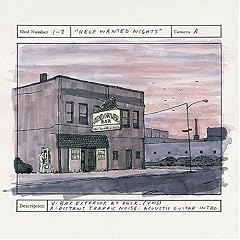
This two track single was released prior to the release of The Good Life's fourth full length album Help Wanted Nights

Track List:
1. Heartbroke
2. Thirty-Year Evaluation

The Good Life - Help Wanted Nights


Four albums in, Tim Kasher is still not set on the direction he wants his side project, the Good Life, to take. He's already toyed with indie electronica bleeps and emo howls, and now, on Help Wanted Nights, he heads toward more singer/songwriter territory, not ditching the full band but using it sparingly, his acoustic guitar the most prominent instrument besides his voice. There are definitely moments of Saddle Creek alt-country, the label that houses both the Good Life and Cursive, heard in the electric guitar, the organ, but the record is what Kasher knows best, indie rock, hinting at Pavement and Sebadoh and even Bruce Springsteen. The songs on Help Wanted Nights are all solid, simple, yet melodic, about running away from home and trying to find home and breaking up, but nothing really stands out. "Heartbroke," sly and quirky, is certainly fun, but it hardly compares to any of the tracks on Album of the Year, let alone Kasher's work with Cursive, and while "Rest Your Head" is nice, Neil Young-y and sweet, it doesn't do much but fade out slowly, nearly ten minutes' worth, into the background. On their last album, the Good Life seemed focused and smart, composing a record that worked both as an entity and as 12 separate pieces, but Help Wanted Nights lacks both the overall vision (despite the fact it was originally meant to be the soundtrack to a screenplay) and individual strength and clarity, the lyrics hinting at cleverness and profundity without ever reaching them ("See, Keely, I love your suffering/Like gravity loves a stumbling drunk," he sings in "Keely Aimee," then going immediately back into trite expressions of obsession and longing and love). Certainly not an embarrassing or even poor effort, but Kasher is not living up to his potential here, needing some more help of his own, perhaps, to get everything back to where it could, and should, be.

-Marisa Brown, All Music Guide

Say Anything - Was A Real Boy


This 7 track album was included with the reissue of ...Is A Real Boy.

Track-list:

1. Wow, I Can Get Sexual Too!
2. Little Girls
3. Most Beautiful Plague
4. It's A Metaphor, Fool
5. Total Revenge
6. Metal Now
7. I Will Never Write An Obligatory Song About Being On The Road And Missing Someone

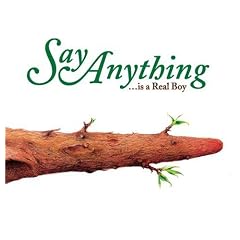
Say Anything - Is A Real Boy


This barely legal L.A. two-piece peddles razorbacked pop-punk hooks grown in a place songwriter Max Bemis calls the "United States of Woe" -- apparently the rocky middle ground between Bright Eyes and bands like Saves the Day. Full of spittle and spleen and literate means, Bemis disses his own "artful abortions of sound, sealed with a kiss and slathered in the sauce sarcastic" ("The Futile") while Coby Linder's thunderous drumming makes Taylor Hawkins sound limp-wristed. Say Anything is premium emo, with frills: "Alive With the Glory of Love" features doo-wop harmonies, and "I Want to Know Your Plans" has a melodica solo.

-PETER RELIC (The Rolling Stone)

Bright Eyes - A Christmas Album


Traditional Christmas songs performed and arranged by Bright Eyes' Conor Oberst and Maria Taylor, along with the help of Jake Bellows, Gretta Cohn, Armand Costanzo, Denver Dalley, Stephanie Drootin, Orenda Fink, Neely Jenkins, Jiha Lee, Andy Lemaster, Mike Mogis, Matt Oberst, Stephen Pedersen, Blake Sennett, Macey Taylor, and Nick White.

Say Anything - Baseball


Max Bemis has never met an emotion he couldn’t make manly. Sex, love, and heartbreak have hardly sounded as nonchalantly masculine as they do when Bemis barks them. Even at the mercy of towering guitar chords, it is Bemis that makes the most powerful effect, and that’s what drives Say Anything as a band and Baseball as an album. Like the best of pop-punk, Say Anything uses the emphasis on punk and chooses to be loud and involving instead of relying on catchy, forgettable hooks, a perfect choice to back up Bemis and his masochistic lyrics. Even LA Weekly lists Say Anything first as a band that is saving L.A.’s music scene, a fitting title to Bemis and the rest of the band’s influence on the genre. Baseball (released back when they were still Sayanything), for what it’s worth, is better than Bemis gives it credit for. He is so unsatisfied with it that it’s now out of print and he won’t play any of the songs at a concert. 200 copies of the album were sold before being discontinued, and go up to $250 on eBay. But Bemis has a point to his actions, and too much of Baseball, as charging as it sounds, falls resoundingly flat to make it live up to what Say Anything can do.

-From www.sputnikmusic.com

Say Anything - In Defense of the Genre


DISC 2


Emo dudes vary the heartbreak guitars with string ballads and a faux show tune for years, say anything leader Max Bemis has had to deal with bipolar disorder, but judging by his band's third album, he's got something else to gripe about -- namely, bad, bad love. Loosely based on one of Bemis' own relationships, the album mostly sticks to serrated emo but ranges from big, string-laden ballads ("Plea") to a faux show tune ("That Is Why"). When Bemis is on --shuffling between a touching Latinate melody and an ace, bloodletting chorus on "Hangover Song," delivering the sugar-rush pop of "Shiksa (Girlfriend)" --his songs are tuneful and invigorating."Retarded in Love" is sort of like a Springer episode: You don't want to watch someone fall apart before your eyes, but you don't want to look away, either. Lyrics about his love interest, a "slender slave with sluttish, sleepy eyes," should have stayed in Bemis' journal. Still, it's hard not root for him -- if he could only handle ladies with the same ease with which he turns out good melodies, he'd be all right.

-
CHRISTIAN HOARD (The Rolling Stone)

First Post!

This is the first post for my music sharing blog.

As of now it's just me.

Each post contains a link to download the featured album for free.
Just click on the picture of the album cover and you will be redirected to a page where you can download the album.

All files are in .zip format, so you will need to extract them to get the music.


Enjoy!